
(This is still actively being worked on. I still don't particularly like the exact way I have some things mapped out. As well as a very brief description. But it's a fun idea that could be even more fun to write! We can completely change everything with more chats!)In the city’s nocturnal hush, Kamari lay awake in the dim, cave-like apartment that served as her sanctuary. The bedsheets were much too thin for the late-autumn chill, and city sounds funneled up the crumbling brickwork, tunneling through her dreams. In the months since she’d left the keep, her world had narrowed to the four walls of this rented space, its single, sputtering lamp, and the ceaseless echo of her own thoughts. Life here was foreign—almost offensively mundane—compared to the long, torchlit corridors and shadow-crowded training cells of the assassins’ guild, where she had spent most of the last decade. She did not recognize the girl who used to sleep with a dagger under her pillow and wake at the scrape of a mouse in the rafters. She did not recognize the girl who had once been so certain of her own monstrousness that she would have killed, or died, for a handful of coin.Training, they called it, when Lyle found her half-starved and soot-sick outside the ruins of what had once been a thriving trade city. She must have been nine, maybe younger, and so malnourished that her own memories of those earliest months came only in flashes: being carried through the charred gates, biting into fruit so ripe its juice ran down her chin, the way her hands trembled so violently she could barely dress herself. Lyle was already a legend—his mere presence enough to hush a roomful of cutthroats. He looked at her with a mixture of pity and calculation, and Kamari saw herself reflected in eyes that had witnessed the extinction of cities. At first, her place was at the edge of things: filling goblets at guild meetings, scrubbing the blood from boot leather, washing laundry until her knuckles bled. The older girls called her Scab and Rat, and nothing delighted the boys more than to trip her as she scurried down the halls with baskets of dirty linen. During these early years, Kamari learned that humiliation was the currency with which the weak bought survival—and that a clever tongue could wound more deeply than a blade.Her inclination for mischief was matched only by her willingness to be punished for it. She spent so many nights locked in the darkness of the keep’s dungeons that she began to map the cracks in the walls, the drip patterns of the leaking pipes, the flavor of mildew in the air. She grew to savor the threat of pain, the anticipation of it, because after the first blow she could always tell how bad it would be. Lyle, exasperated and secretly amused, once threatened to cut her tongue out if she couldn’t keep it still. She had laughed, or at least tried to, before being sent to cool off in the solitary cells. It was only weeks after her last stint in punishment that she was confronted in the drawing room by four of the older apprentices. She remembered the taste of iron in the air, remembered the panic at being cornered and overwhelmed, but could not recall what happened next—only the shocked silence after, the way all four attackers stepped away from her as if she had suddenly become unclean, a wild thing. Blood had poured from the cheek of the smallest boy, a coppery stream that pooled on the stone, and when Kamari finally looked down she realized her own hands were steady, locked in a death grip around the hilt of a bloody dagger.From that day onward, the teasing stopped. The other apprentices called her Ghost, sometimes Cat, and kept their distance. Lyle never spoke of the incident, but Kamari could see something new in the way he regarded her: a flicker of genuine respect. From then on, her training shifted from humiliation to harnessing the feral, unpredictable energy he’d seen in her. She took to it like a creature who had always wanted to hunt, learning poisons and lockpicking and the art of vanishing into shadow. By the time she was sixteen, she was running her own jobs, taking contracts that would have broken the older, slower assassins. At nineteen, she was certain she would never need anyone again.And yet, in the city’s thin-walled, anonymous rooms, Kamari found herself acutely aware of every voice that passed her door, every step in the hallway, every breeze that slipped through the cracked window. The only thing of value she had brought with her from the keep was a battered trunk, stuffed with every tangible memory of her old life: a pair of knives, a wax-sealed ledger, and a handful of gold coins she’d spent years amassing. She had thought, naively, that the gold alone would buy her freedom. On the day she decided to leave, she marched into Lyle’s study and upended the trunk onto his desk, sending coins, ledgers, and knives cascading over his paperwork. Lyle didn’t even flinch. He looked at her, looked at the gold, and then at the contract he had ready—a contract she had forgotten existed, one she had agreed to as a child, binding her to the guild for a decade or three “notable services.” The silence in the room was as heavy as a sealed vault. Neither spoke; they did not need to. Kamari’s message was clear: she would never again be a pawn.But Lyle’s message was clearer still: the game was not yet over.That damned letter had been waiting for her when she returned from her errands the next morning. It sat on the wobbling nightstand, its wax seal as perfect and implacable as a death sentence. For weeks she pretended it wasn’t there, refusing even to touch it save for those strange hours before dawn when sleep was a lost cause and she found herself tracing its edges with her thumb. In the end, it was a simple, four-line missive: the king had only one heir, a “delicate” boy of seventeen whose existence was the lynchpin holding the entire region’s peace together. Remove the prince, and every power-hungry noble and foreign rival would descend like vultures at a feast. Her task was to find a way past the castle’s notorious defenses, kill the prince, and escape—if she could.Kamari read the contract three times, looking for the trick, the clever twist that would make it impossible. But no, it was as straightforward as they came: death or success, nothing in between.She huffed, a dry laugh catching in her chest, and sat on the edge of her bed. The letter’s presence was a challenge, and even now, after all her years in the guild, she was not immune to the thrill of a new job. She stared at the ceiling for a long time, replaying in her mind the rumors and stories she’d heard about the royal castle and its ruthless guard. Many had tried to breach the walls; none had ever come back. Some claimed the gardens were haunted, patrolled by silent, faceless men who could kill a sparrow with a glance. Others said the castle’s western gate was cursed, and that those who entered it died before they reached the first stair. Kamari had heard all these tales and more, and yet, she did not shy from them. She had survived worse.Resolute, Kamari stood and reached beneath her pillow, retrieving the old dagger that had once made her legend. She drew the blade over her thumb, marking the contract with a neat, bloody print—her signature, her acceptance, her refusal to let the guild break her. She would kill the prince, and then she would vanish, leaving Lyle with no leverage, no further claim on her life. Two contracts in one, she thought. That would be her final act.The days that followed were a blur of preparation. She spent hours in the city’s lower markets, picking up rumors and watching the castle gates from a dozen vantage points. She trailed servants through the winding alleys, mapping their paths, noting which ones lingered at the market stands or slipped away for secret assignations. She learned the name of every guard captain, the shift changes, the baker who delivered bread to the royal kitchens. At night, she practiced the old routines: scaling walls, squeezing through narrow gaps, moving so quietly as to become invisible. She slept little, ate less, and by the second week the city’s streets seemed to pulse beneath her feet, alive with secret intent.Still, she could not shake the sense that this contract was different—that she was being watched, measured, studied just as she had once studied her prey. On more than one occasion, she caught glimpses of a figure in the crowds, never close enough to see clearly, but always present. Once, returning to her apartment at dusk, she found the lock broken and the window ajar. Nothing was missing but the letter had been moved, angled differently on the nightstand as if someone had read it, or left it as a warning. Kamari responded by doubling her precautions, sleeping with one hand on her knife and the other curled around the hilt of a short sword she’d purchased from a black-market dealer. She adopted new routes through the city, changed her appearance, and gave up any thought of comfort.The mission was everything, and the clock was ticking.Four Months LaterIt began with a single, fatal miscalculation: the belief that she could vanish into the city wearing the anonymity of a common tradeswoman, and not as a wolf amidst the sheep. The King’s guard held an open competition, a public charade meant to demonstrate his benevolence and the court’s faith in meritocracy. The notice had been posted at every corner, each broadside bearing the royal crest and the promise of reward: “A Place in the Guard, Gold, and Honor to the Worthy.” Kamari, now calling herself Nyssa, arrived the morning of the first trial dressed in the patched uniform of a retired mercenary, her hair cropped short and her face smeared with the dust of the road. The name she provided was an invention, but the skills she brought to the contest were not.When they called her name, the murmur of the crowd was more incredulous than derisive. There had been women in lesser patrols, in distant provinces and border wars, but never in the King’s personal guard—never so openly, and never by right of competition. The other candidates were a gallery of stereotypes: brutes with hands like stone mallets, sons of minor nobles fattened on privilege, a scattering of career soldiers desperate for one last shot at glory. Kamari saw at once which of these men would die in the first round, and which might actually warrant her attention. She lined up with the others in the shadow of the drill yard’s east wall, feeling their stares, their half-suppressed laughter. They had no idea what she was, and that was the point.
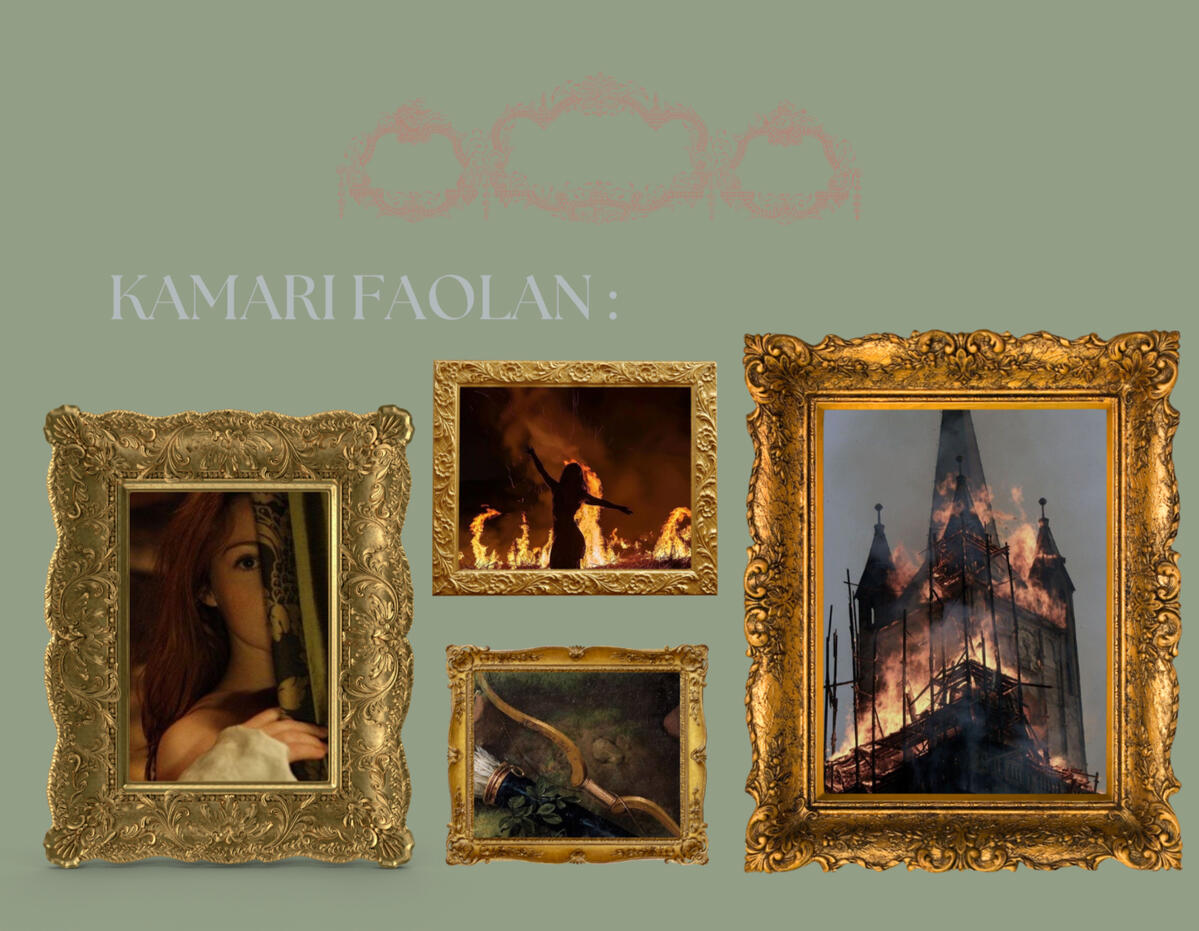
Kamari Faolan’s red hair falls down her back in a tangle of curls that she never bothers to tie back. Her eyes are the color of old glass bottles, and they move constantly—doorways, faces, hands. She is not tall, but she carries herself as though she has decided to be.
She is young enough that people sometimes make the mistake of saying so. The scar that runs along the inside of her left forearm is older than most of her possessions. She walks the way water moves around a stone—not avoiding, exactly, but choosing. When she laughs, which is rare, it does not reach her eyes, which are already somewhere else.